Fearna Storage
The Project
The Fearna Storage project is a proposed pumped storage hydro (‘PSH’) scheme with an installed capacity of up to 1,800MW. The Fearna project will be one of the largest such scheme in the UK in terms of generating and energy storage capacity.

PSH Project
Pumped Storage Hydro
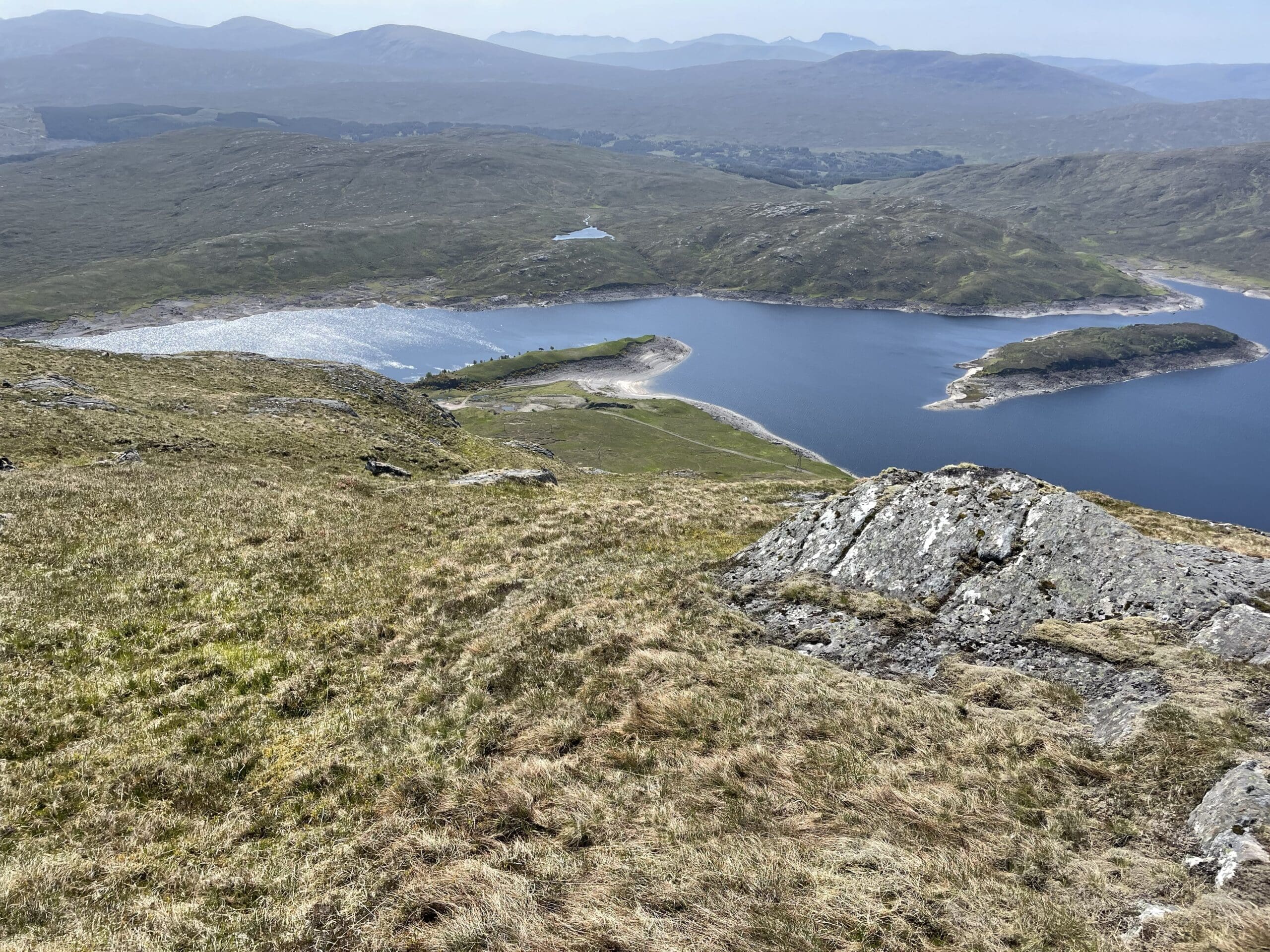
The Fearna PSH project will store approximately 37,000MWh of energy and have an installed capacity of up to 1,800MW which will make it one of the largest such scheme in the UK. The impressive generation capacity and energy storage figures are matched by the site characteristics which are ideal for a pumped storage hydro project. This includes the geology and topography around the existing upper Loch Fearna which is a natural ‘bowl’ shape, and therefore allows straightforward modification to form a new larger upper reservoir which will blend sensitively into the landscape. The distance between the upper and lower reservoirs at 1km is very short relative to comparative schemes which means the cost and time taken to construct the tunnels is minimised.
Clean Energy
CO2 Savings and Local Employment
The Fearna Storage development would be a major civil engineering project. It is anticipated that the construction period would last approximately four to five years and the workforce would average around 400 people on-site throughout this construction phase.
The development of the Fearna Storage project will bring multiple benefits to the country both in terms of a clean energy supply and savings to the electricity consumer. The large amount of energy stored by the project means that it will both store significant amounts of surplus wind energy, which would otherwise be lost, and displace conventional gas generation and hence reduce emissions.
The proposed scheme has the potential to rapidly supply clean electricity to the national grid, powering over 1.5m UK households per year and saving over 2 million tonnes of CO2 annually.
Why is Fearna a great project?
To make a meaningful difference to the UK system, significant additional capacity in terms of both power (measured in MW or GW), and stored energy (measured in MWh or GWh) is required. Sudden significant increases in generated or absorbed power are often required: for example when weather patterns change, in emergencies such as when a nuclear power station trips, or when a sporting event results in big changes in demand, such as when a world cup football match goes into half-time. But fast-reaction power increases or decreases are only part of the solution.
As the UK transitions away from a system dominated by large on-demand thermal generation, to one dominated by intermittent renewables it becomes increasingly challenging to balance the grid. Weather patterns especially wind, rather than the hourly changes in demand during the day, become the dominant factor. To balance longer consecutive periods of low wind or high wind (which can last many hours, or even days), long duration energy storage is required. Large-scale, long-duration energy storage ‘LDES’ is typically understood to mean anything above 4hrs duration but our analysis suggests at least 12hrs storage is required in order to provide an optimum balancing service to the grid. So along with power, large quantities of energy are also required.
The Fearna PSH project ticks both boxes:
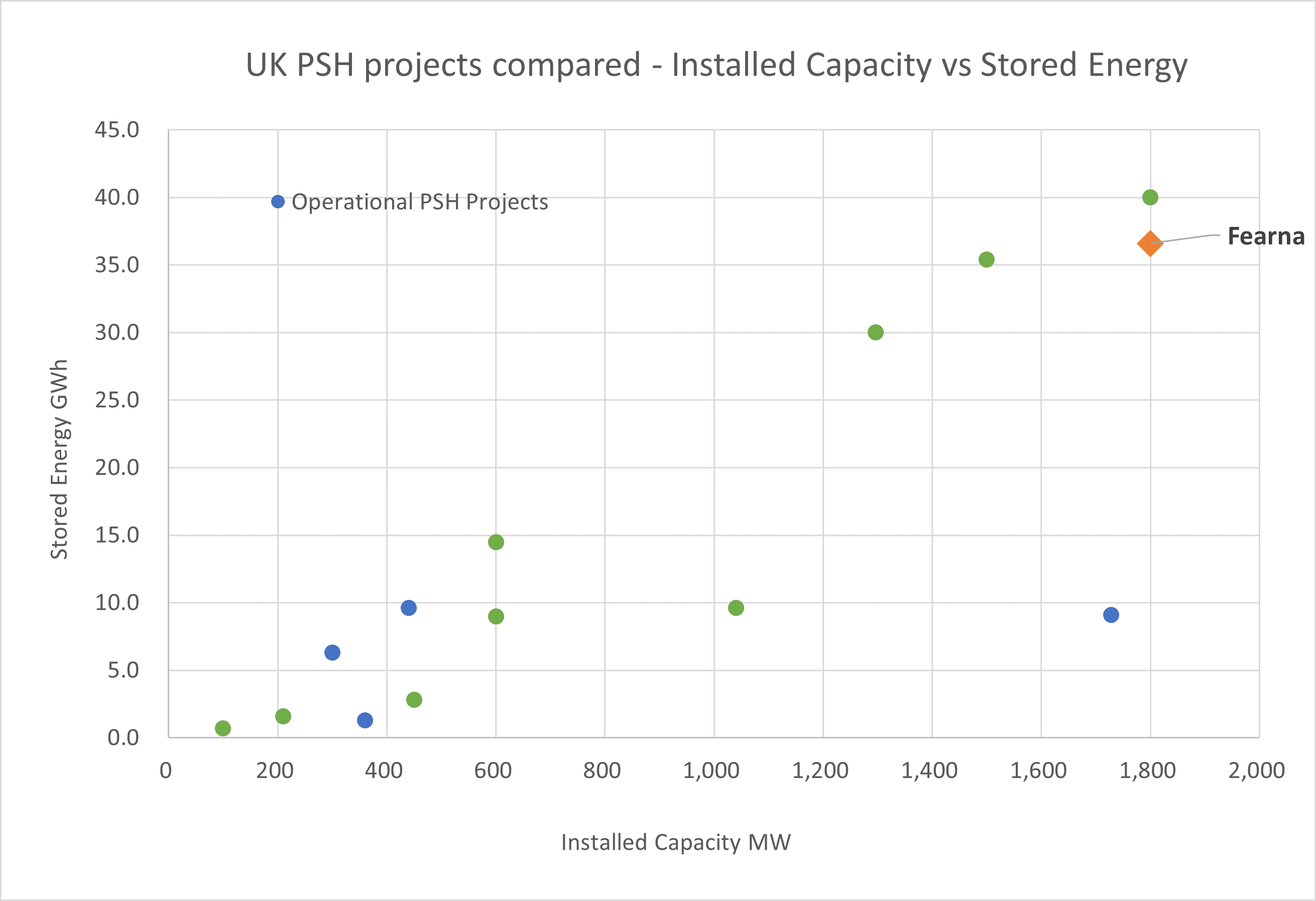
It provides both significant quantities of power (up to 1,800MW) and stored energy (up to 37GWh). In fact when compared with other PSH projects it scores very highly.
The chart below shows the power and stored energy ratings of Fearna (orange dot) compared with the four existing operational PSH projects in the UK (blue dots) and any PSH projects in development (green dots). Fearna’s position on the upper, right-hand part of this chart shows it to be one of the biggest and best PSH development projects in the UK.
The Location
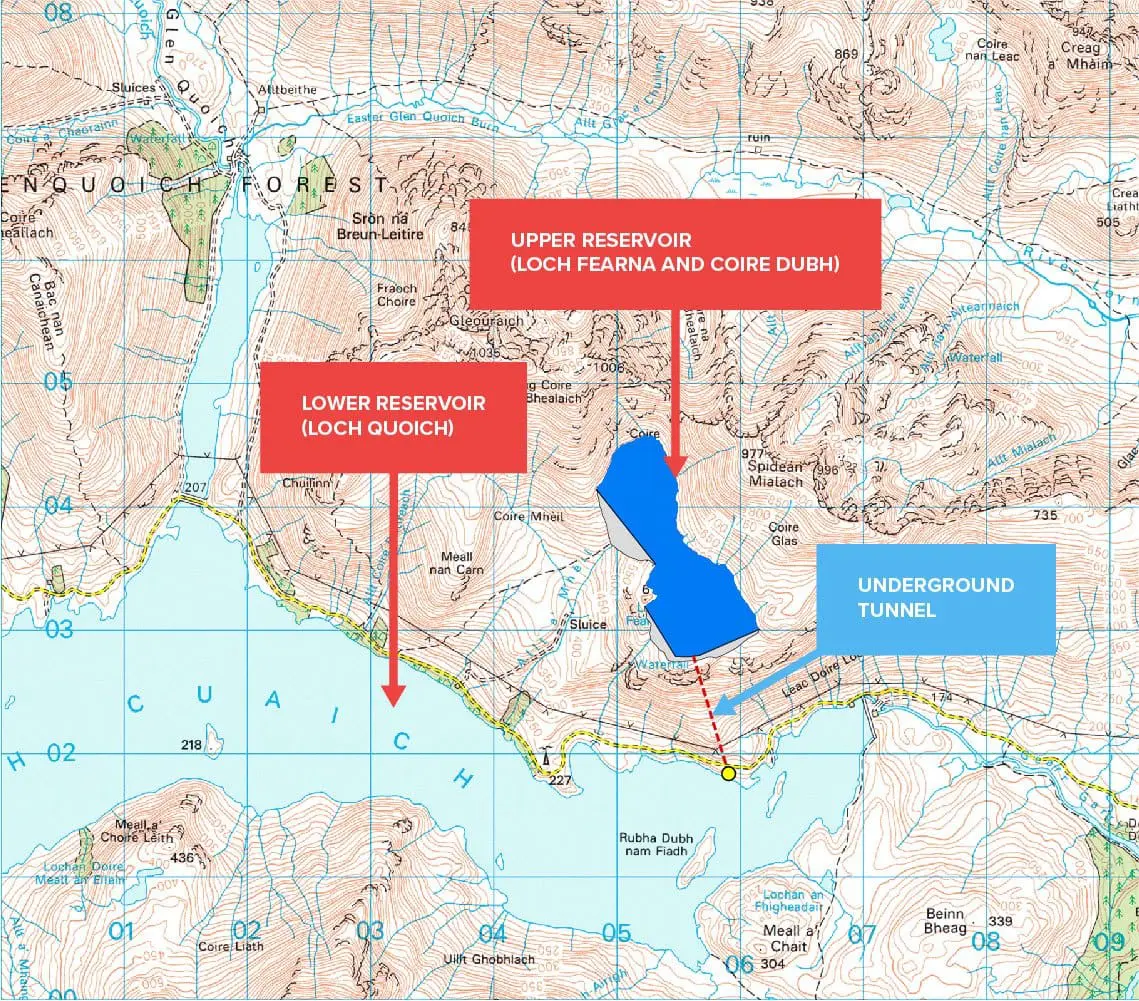
The proposal is to use Loch Quoich as the lower reservoir and Loch Fearna and Coire Dubh as the upper reservoir.
Tunnels approximately 1km long will connect the two water bodies.
A powerhouse will be constructed on the shore of Loch Quoich which will extend deep underground. The turbines will be located at the bottom of the powerhouse shaft and will generate electricity in times of national demand or pump water for energy storage in times when there is surplus electricity on the national grid.