Fearna Storage
Why Pumped Storage
As the UK System transitions from being dominated by ‘on-demand’ thermal generation to intermittent renewables, it becomes increasingly difficult to balance electricity supply and demand.
Energy Storage
WHY PUMPED STORAGE HYDRO ‘PSH’?
Energy storage allows energy produced during times of excess generation (mainly wind) to be stored and released later when there is a deficit of renewable energy. Pumped Storage Hydro ‘PSH’ projects are in effect very big batteries.
PSH is a mature, proven, long-lifespan (100yr+) technology which has the ability to deliver large capacities of energy storage for long durations. The energy can be delivered at a competitively low cost per unit of power capacity and per unit of energy stored when compared with other technologies.
By developing and investing in PSH capacity, we are helping more renewables to be added to the UK System, displacing expensive and carbon-emitting gas generation and ultimately speeding up the transition to a clean, carbon-free economy and helping to meet Scotland’s climate change target of net zero by 2045.
The Fearna PSH project is the second PSH project we have launched following the Earba PSH project earlier in 2023.
About Us
We are a small multi-skilled team which includes a full suite of engineering, consenting, project management, commercial, financial and legal expertise ‘under one roof’. We are straightforward to work with, deliver results and enjoy what we do.
To learn more, click the button below.
Quantifying the Long Duration Energy Storage opportunity
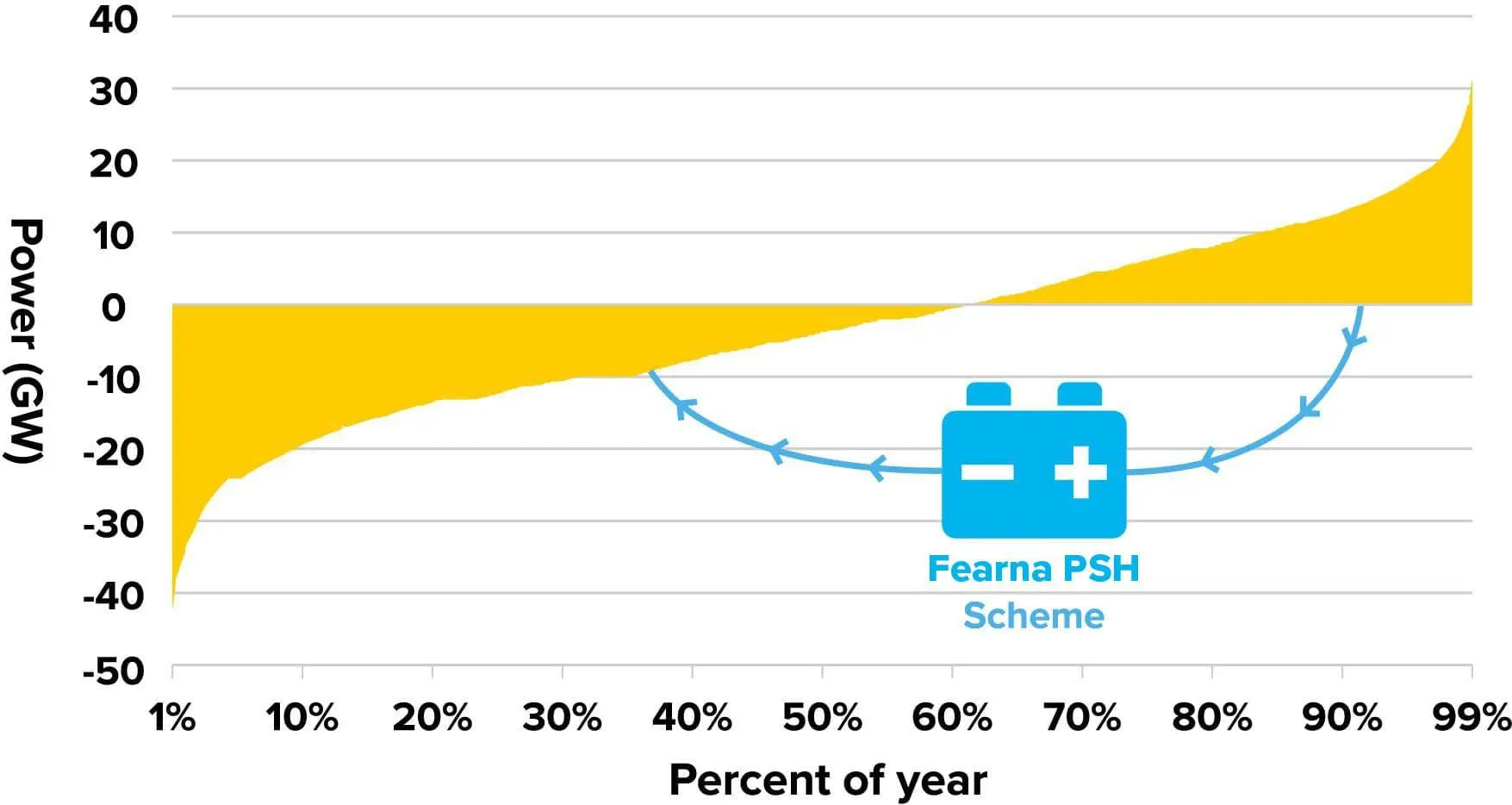
The chart above shows the potential shortfall (‘Deficit’) and excess (‘Surplus’) of renewable output on the UK electricity system by 2035.
The problem: too much curtailment and gas generation
The yellow section on the left represents the amount of energy shortfall in an average year; or in other words the total amount of electricity required in excess of that produced by low carbon sources. You can see from the chart that for about two thirds of an average year the UK isn’t expected to produce enough low carbon generation to satisfy demand. And the volumes are huge – measured in TWh (Terrawatt hrs) not GWh or MWh! At the moment the only answer to this problem is gas generation. In 2022 the UK requires significant volumes of gas generation – which is carbon producing and of very volatile cost. If we are to wean ourselves off gas generation and achieve Net Zero an alternative to gas generation is required.
The yellow section on the right represents the amount of energy surplus in an average year; or in other words the total amount of electricity produced by low carbon sources in excess of demand. You can see from the chart that for about one third of an average year the UK is expected to produce more low carbon generation than is needed to satisfy demand. At the moment most of this energy is wasted in the form of ‘curtailment’. Curtailment is the name given to the practice of turning off renewable generators (mainly wind farms) when there is nowhere for the power to go, despite the wind blowing. Additionally wind farms have to be paid to turn off, and most of this cost is passed onto consumers. So wind curtailment is wasteful and expensive.
The solution: large-scale, long-duration energy storage ‘LDES’
Energy storage is a solution to both the above problems: it both reduces wind curtailment by taking power (ie charging batteries, or pumping water uphill) during periods of Surplus (that would otherwise be lost forever), and reduces gas generation by dispatching stored wind energy during periods of Deficit. In simple terms an energy storage project such as the Fearna Pumped Storage ‘PSH’ scheme takes energy from the right hand yellow triangle on the chart above (ie in times of Surplus), stores it for a period of time, then passes it to the left hand yellow triangle when required (in times of Deficit). And in doing this it benefits society as a whole because it is allowing the country to waste less wind energy in the form of curtailment, and is reducing gas generation.
The volumes of energy which need ‘shifting’ in this way are immense however. Battery storage (Li-Ion) and interconnectors are part of the solution but the need to balance power across weeks, months and seasons means there will be a need for significant additional storage capacity. And in the future the rapid increase in deployment in renewables means there will be even longer periods of time where there is an excess in renewable generation. A typical 50MW 2hr battery stores 100MWh of storage. The Fearna PSH project will store up to 37,000MWh – so the equivalent of 370 battery projects. Which is why a number of large-scale, long-duration energy storage projects such as Fearna PSH are required: to make significant steps towards Net Zero whilst keeping the UK electricity system balanced, all at a sensibly low cost.
The Fearna PSH Project is one of the most attractive large-scale, long-duration projects under development in the UK as it provides significant quantities of both power and energy.